1. Motivation

在精排阶段需要利用多目标预测对多个指标(如购买、评论、关注)分别进行预测,各自得到一个分数之后再通过集成模型最终输出一个精排分数。这个集成模型一般通过同时优化每一个指标的二分类交叉熵来训练:
\[\begin{equation} \mathcal{L}=\mathcal{L}_{CE}(y_{buy},\hat{y}_{buy}) + \mathcal{L}_{CE}(y_{follow},\hat{y}_{follow}) + \mathcal{L}_{CE}(y_{comment},\hat{y}_{comment}) \end{equation}\]这种范式存在两种显著缺陷:
- 二分类任务的优化方向和排序任务的目标(即 AUC 指标)不一致。
- 忽略了各个目标之间的对齐关系,如:评论和购买行为往往存在一定相关性。
2. Methodology
2.1. AUC 对齐
我们已有一个离线数据集 $\mathcal{D}={(x_i,y_i)}_{i=1}^N$。对于第 $i$ 个样本,我们通过预估模型和集成模型得到一个精排分数 $s_i\in[0,1]$,则 AUC 的定义如下:
\[\begin{equation} \begin{aligned} \mathcal{G}_m(\mathcal{D})&=\frac{\sum_{s_i\in\mathcal{D}_m^+,s_j\in\mathcal{D}_m^-}\mathbb{I}(s_i\ge s_j)}{|\mathcal{D}_m^+|\cdot |\mathcal{D}_m^-|}\\ \mathcal{G}(\mathcal{D})&=\frac{1}{M}\sum_{m=1}^M\mathcal{G}_m(\mathcal{D}) \end{aligned} \end{equation}\]其中 $\mathcal{D}_m^+$ 表示关于行为 $m$ 的正样本,$\mathcal{D}_m^-$ 表示负样本。
由于上式不可微,因此不能直接优化。现有的 AUC 优化方法一般都是寻找一个可微的函数来替代指示函数 $\mathbb{I}(s_i\ge s_j)$ 来将 AUC 作为训练目标。
AUC 也可以用下面的 rank-sum 方式来计算(经典八股):
\[\begin{equation} \mathcal{G}(w)=\frac{\langle r,y\rangle - |\mathcal{D}^+|(|\mathcal{D}^+|+1)/2}{|\mathcal{D}^+|\cdot |\mathcal{D}^-|} \end{equation}\]其中,$r=\text{Rank}(s)$ 表示按照精排分数对所有 candidates 降序排序后,每个样本的排名。
例:假设有5个样本(正负样本都有),其精排分数为 s=[0.7,0.2,0.8,0.1,0.9],则 r=[3,4,2,5,1]。
因此,我们只需要最大化 $\langle r,y\rangle$ 项即可。
这里问题在于 $\text{Rank}(\cdot)$ 依然是不可微的,因此作者提出使用可微分排序算法来优化。
原始的排序问题可以表示为在一个所有可行排列的集合 $\Sigma$ 上寻找一个排列 $\sigma$,使得目标函数 $\langle s,r_{\sigma}\rangle$ 最大化:
\[\begin{equation} r^*=\arg\max_{\sigma\in\Sigma}\langle s,r_{\sigma}\rangle \end{equation}\]作者通过引入了集合 $\Sigma$ 的凸包 (convex hull),即置换多面体 (permutahedron) 来将上述的离散优化问题变得可微:
\[\begin{equation} \mathcal{P}(r):=\text{conv}\{ r_\sigma\mid\sigma\in\Sigma \} \end{equation}\]为了将问题转化为连续可微的优化问题,作者引入了一个二次正则化项,至此就可以把损失函数写成 MSE 的形式:
\[\begin{equation} \begin{aligned} P(s,r) &=\arg\max_{t\in\mathcal{P}(r)}\langle s,t\rangle-\frac{1}{2}\|t\|^2\\ &=\arg\min_{t\in\mathcal{P}(r)}\|t-s\|^2 \end{aligned} \end{equation}\]2.2. 优化目标对齐
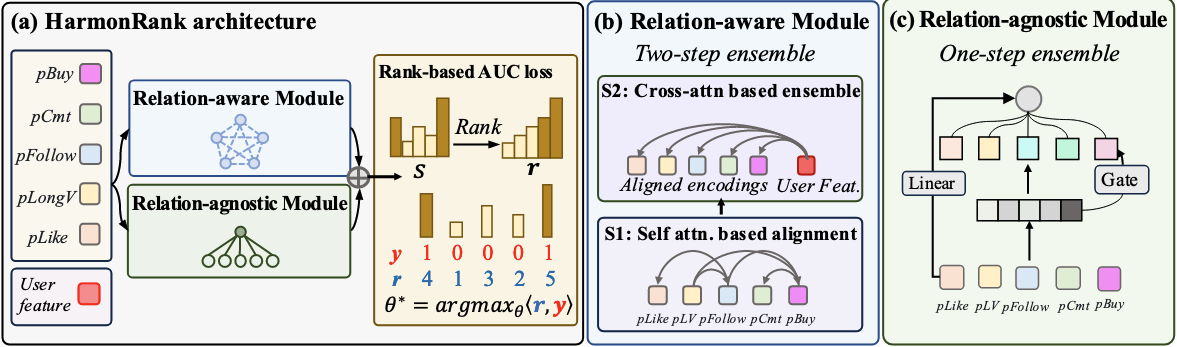
为了在不同的优化目标内部进行对齐,作者设计了两个通道分别对多目标分数进行融分:
- Relation-aware Module:两步融分
align-then-ensemble。第一步使用 self-attention 捕捉不同目标之间的关系,再使用 cross-attention 将各种分数融合到 user profile 表征上。 - Relation-agnostic Module:一步融分。使用一个 gating 模块来学习每个分数的权重。
最终的精排分数就是两个模块的输出分数之和。
3. Experiments
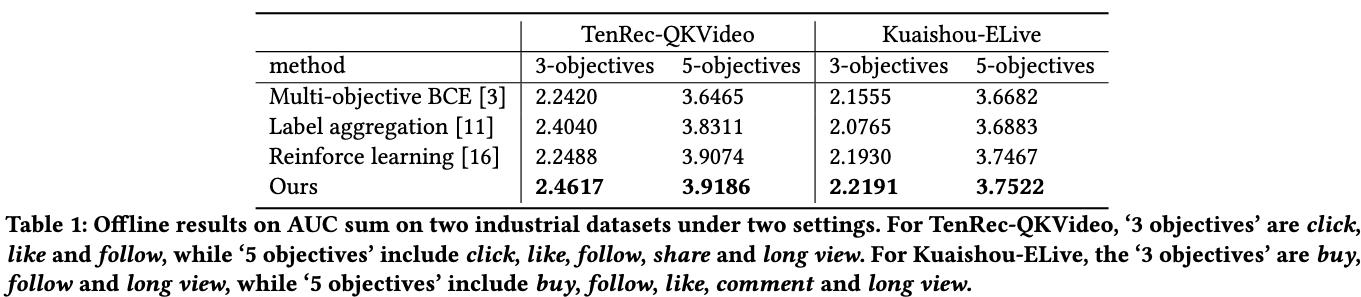
3.1. 端到端指标
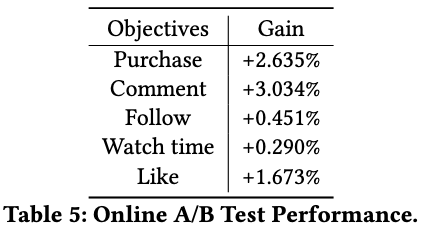
3.2. 不同业务指标之间的trade-off曲线
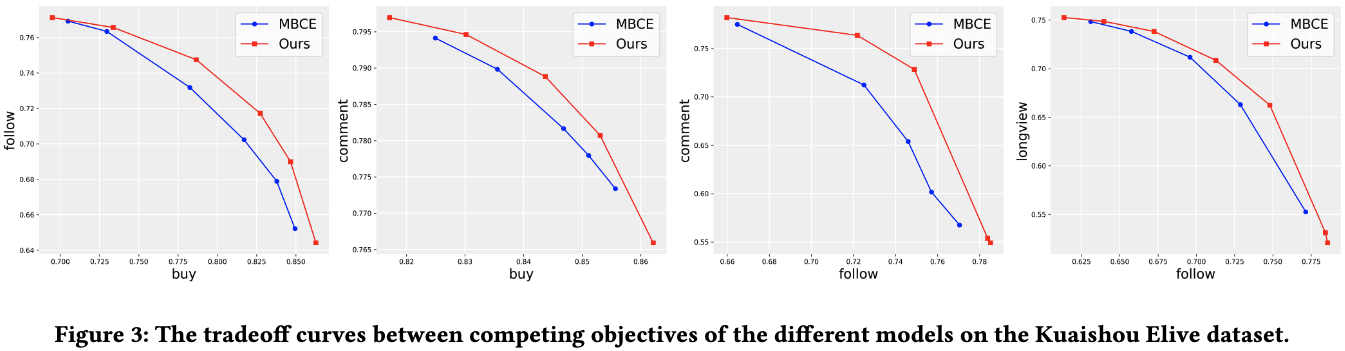
可以看到,HarmonRank可以让各种业务指标都保持相对较高的水平。